
Freedom
A Boy's First Glimpse of America

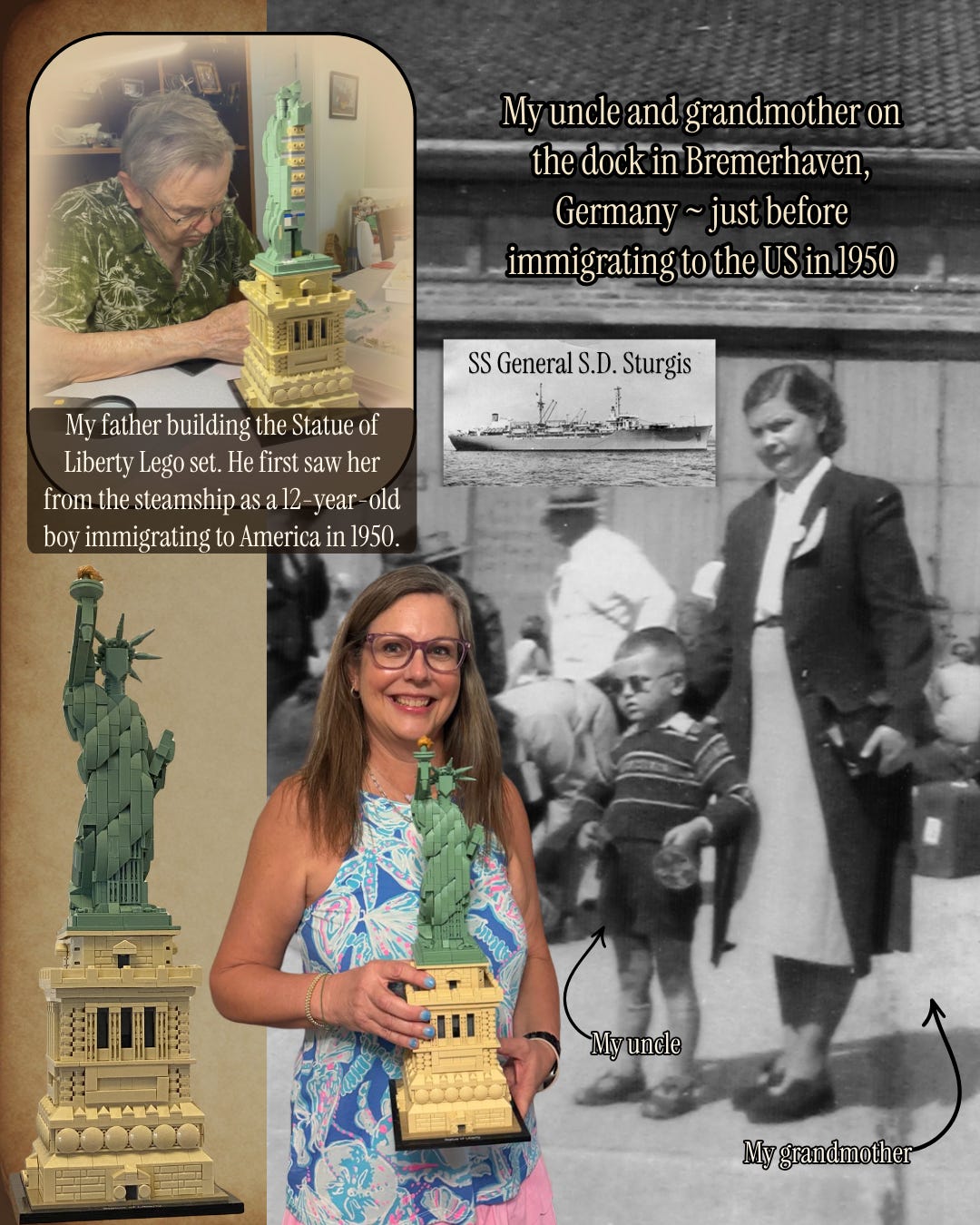
A few days ago marked the 76th anniversary of my father’s family’s arrival in the United States. On July 12, 1950, at just 12 years old, he sailed into New York Harbor with his parents and 4-year-old brother, after years of war, displacement, and uncertainty.
I rediscovered an essay my father wrote when he was 76 years old. He titled it simply, “Freedom.” In it, he recalls that life-changing voyage across the Atlantic from Bremerhaven, Germany, to New York.
Note: My father, George Buzyna, wrote this essay in the third person in April 2014 as an assignment for a writing class. In February 2024, I adapted it to the first person for readability. The substance of his story remains unchanged.
At the young age of 12, I stepped off a train at the port of Bremen, Germany, with my parents and 4-year-old brother. We were part of a large group of people, mostly Eastern Europeans, who were survivors of the Second World War. For the last five years, we have lived in various refugee camps in West Germany. We were known as Displaced Persons, or DPs for short; people with no country, no home, and no future. But on this day, the Second of July 1950, we were about to board a ship that would take us to a new land with a promise of a brighter future and finally of freedom. We came aboard a former troop ship, the USS General S. D. Sturgis, assigned to transport refugees across the Atlantic Ocean to the United States of America.
There was naturally a lot of excitement in the air as passengers came on board. My brother Leonid and I had to be restrained a bit and told to be patient and stay in line. On board, along with all the passengers, we were given a welcome, a general orientation, and shown to our assigned accommodations. Our beds were bunks, stacked in large compartments of the ship. There were so many compartments and bunks that it was easy to get lost at first. Women and children were given separate quarters. I naturally wanted to be with my mother, but discovered that I was now classified as a man and that my place was with the men. Hesitant at first, to be separated from my mother, I eventually became proud of my new status.
As things settled down a little, the ship was ready to depart. I was on deck now, watching everything with great interest and excitement. I watched the parting of the sea as the ship steamed ahead and the ship’s wake that formed and disappeared behind. Shore birds, gulls, and finally the harbor slowly receded from my view. Sea gulls were devoted escorts, but soon they waved goodbye and wished us a safe journey. Now, new escorts have appeared. Flying fish emerged in flocks from the sea, glided above its surface, and disappeared again from view. Thereafter, there was not much to see, just noisy waves and more waves and the distant and limitless horizon as far as I could see. These sights were all new to me. I remained a long time on deck, rolling and rocking with the waves and just having fun before finally stepping down onto the ship. But now I noticed something was wrong! My stomach felt funny. My appetite was gone. The sea was not about to let this land creature get away so easily. I needed a new lesson now! “Welcome to motion sickness, boy,” the sea hissed at me. Oh, I feel so awful. I heard a call for dining from below. Have some pea soup and green celery. Oh no, it made me even sicker now. No food for me, thank you very much. I was not hungry anymore.
There were a few more days like this before I finally felt normal again. I felt a little slimmer, and my appetite returned. Going below deck for meals was no longer a problem. However, the association of motion sickness with green pea soup and green celery remained with me forever. Days passed quickly. The view did not change from day to day. Except for the day when huge black clouds appeared on the horizon and headed directly for the ship. Soon, the sea water below and rain and thunder above showed no mercy for those on the ship. The ship was tossed violently about like a piece of driftwood. I was horrified and deathly scared. I found my mother and wanted to be with her if we should perish.
This experience reminded me of another fearful occasion during the last days of the war. Then, in anticipation of imminent bombing and the approach of the Allied (American) forces, citizens were directed to various shelters. Our refuge had been in a farmhouse in the suburbs of the city [Ingolstadt]. German citizens generously offered shelter to my family and other families like us. During bombings, both the homeowners and refugees suffered while huddling together in a basement corner awaiting the war’s end. Bombs with bone-shattering noise fell at night. The bridge over the Danube was blown up by the retreating German Army. My mother held me tightly all that night.
The violent storm finally passed, and we were all back to normal cruising again. Boring days returned. I was getting more and more impatient. It was the ninth day. Wasn’t there supposed to be something on the horizon by now? We must have been off course, I thought. In the early morning of the tenth day, there was commotion on board. Land had been sighted. Quickly, I ran on deck. At first, there were buildings I had seen in pictures. As the ship traveled closer to shore, the buildings grew ever bigger. Wow! This is grand, I thought. I became glued to this magnificent scenery for a long time. Then, suddenly, I saw it. It was there in front of me. I felt a rush of adrenaline and a high state of excitement. There she stood: the Statue of Liberty, by God! I saw her pictures in the books. This was not a dream; this was for real. This was America, the United States of America! How beautiful and sweet it was. Soon I would be on American soil, where I had dreamed to be. With my family and all those on the ship, we would finally be free of post-war life as refugees. Hurrah! Thanks be to God and to the United States of America. God bless America!
Oh, that’s beautiful, Tamara. You must be so proud. 🥲